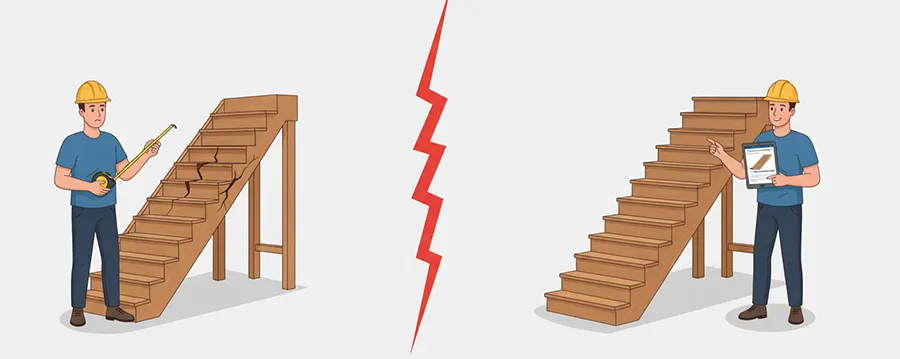
Building stairs is an exercise in precision. One wrong measurement cascades through the whole project and leaves you with stairs that are uncomfortable, look amateur, or are downright dangerous. The good news: nearly every costly mistake is avoidable. Here are the seven we see most often, and exactly how to avoid each one.
In this guide
Mistake 1: Measuring the total rise incorrectly
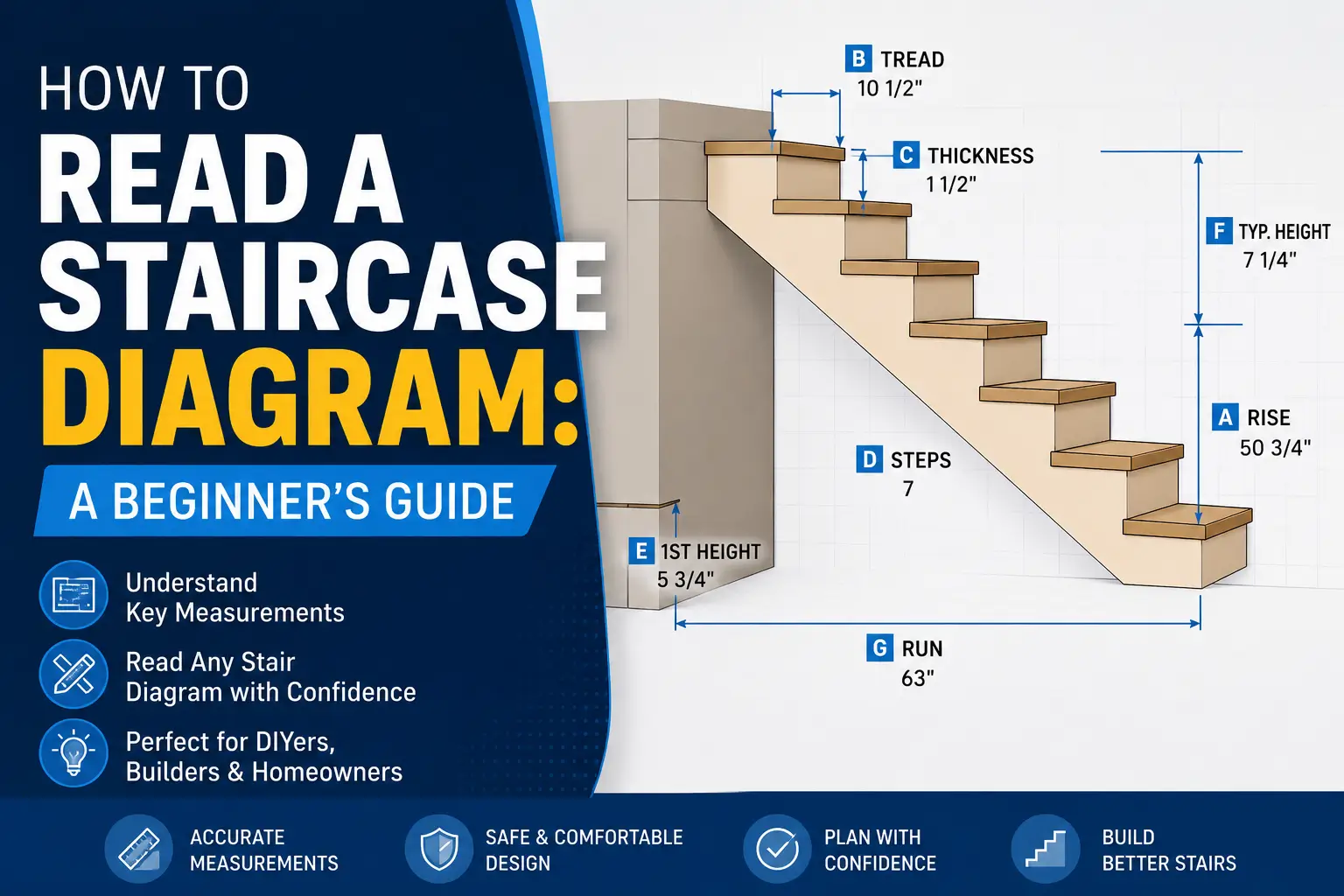
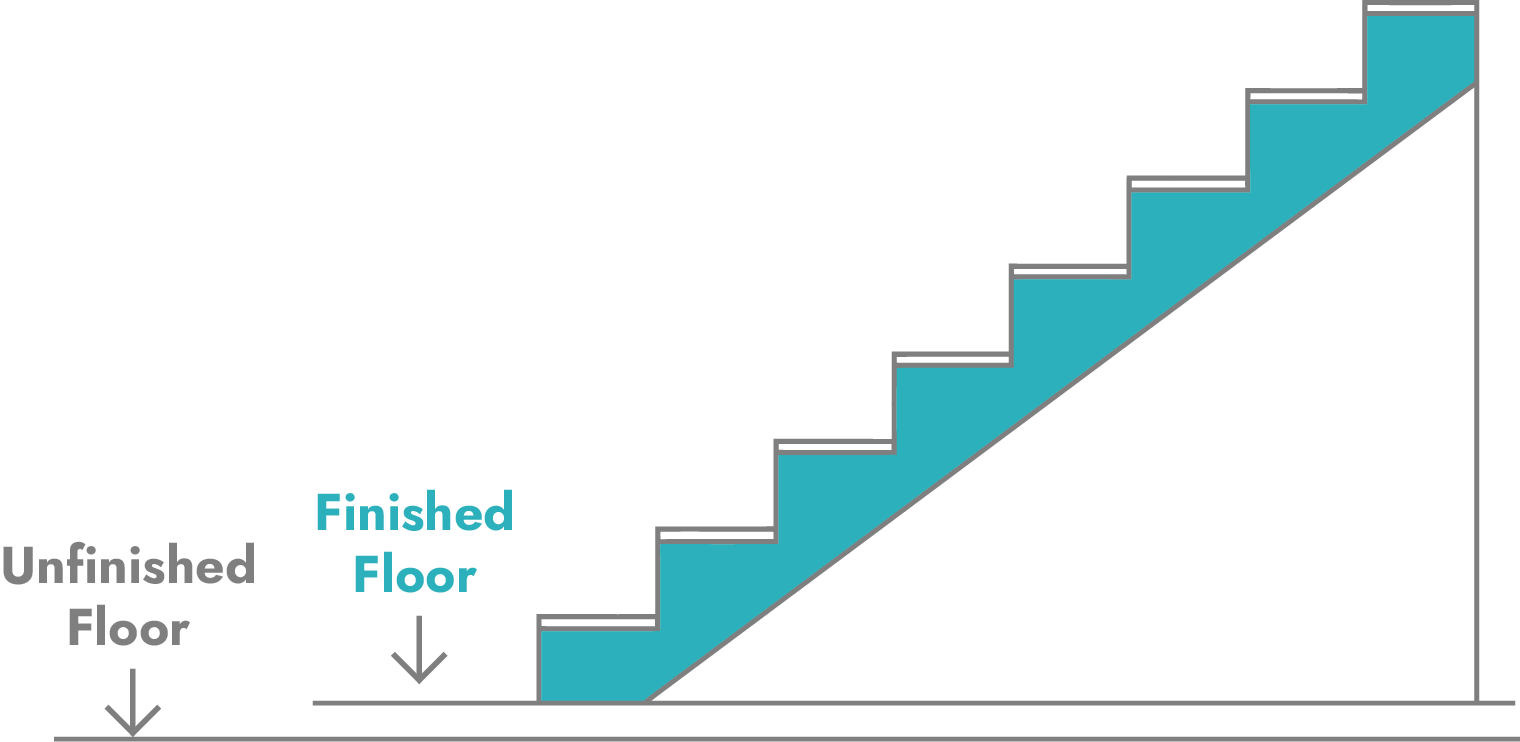
The total rise — the vertical distance between the finished lower floor and the finished upper floor — is the number every other calculation depends on. If it is wrong, every step is wrong.
How to avoid it
- Measure finished floor to finished floor. Don’t measure subfloor to subfloor unless you add the exact thickness of the flooring at both ends. If you can, wait until the final flooring is installed.
- Use straight, rigid tools. A tape measure can sag over a long distance. Extend a long level straight out from the upper floor and measure down from it, or use a laser level.

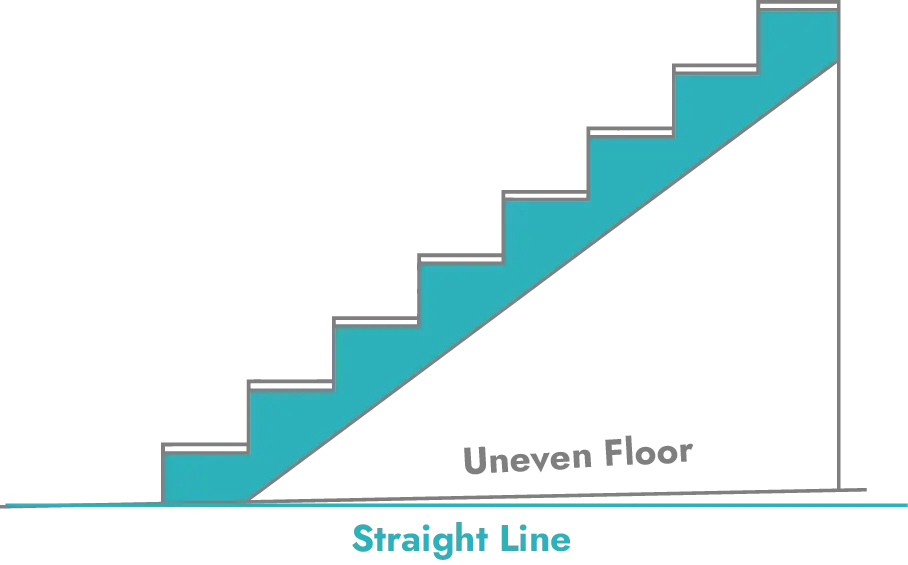
- Check several spots. Floors and ground are rarely perfectly level. Measure where the stairs will actually start and end, and account for any slope.
Mistake 2: Creating uneven riser heights
This is a serious safety issue. Our muscle memory expects every step to be the same height. A riser just ¼ inch taller or shorter than the rest is enough to trip someone. That is why the IRC allows no more than 3/8 inch of difference between the tallest and shortest riser in a flight.
How to avoid it
- Divide the total rise by a target riser height (for example, 7½ inches) to estimate the number of risers.
- Round to the nearest whole number. That is your riser count.
- Divide the total rise by the riser count to get the exact riser height, so every step is identical.
The stair rise and run calculator does this automatically. It rounds the riser count up so no step is taller than your target, and it flags any riser over the 7¾" code maximum.
Mistake 3: Miscalculating the stringer layout
The stringer is the backbone of the stair, and stringer mistakes waste expensive lumber. The most common one is forgetting about the thickness of the treads.
How to avoid it
- Drop the stringer. After marking all the rise and run cuts, cut the bottom of the stringer down by the thickness of one tread. Once the treads are installed, the first step will then be the same height as the rest. The calculator shows this as the first stringer rise cut.
- Use a framing square with stair gauges. The gauges lock in your rise and run so every notch you mark is identical.
Mistake 4: Overlooking headroom
A mathematically perfect stair is still a failure if people have to duck. Codes require at least 6 feet 8 inches (80 inches) of headroom, measured vertically from the sloped line connecting the tread nosings to the lowest obstruction above.
How to avoid it
- Know your local requirement and confirm it with your building department.
- Check during design. Find the tightest spot — usually where the stair passes under a floor joist, beam, or the edge of the stairwell opening. If headroom is short, you may need to lengthen the opening, move where the stair starts, or change its configuration.
Mistake 5: Ignoring minimum tread depth
When builders focus on the rise, they sometimes squeeze the treads. Shallow treads are a real hazard, especially going down, because there isn’t room for the whole foot.
How to avoid it
- Meet the code minimum. Most residential codes require at least 10 inches of tread depth.
- Use comfort formulas. One riser plus one tread should be about 17–18 inches, and two risers plus one tread about 24–25 inches. The stair calculator checks this stride rule for you.
Mistake 6: Using too few stringers
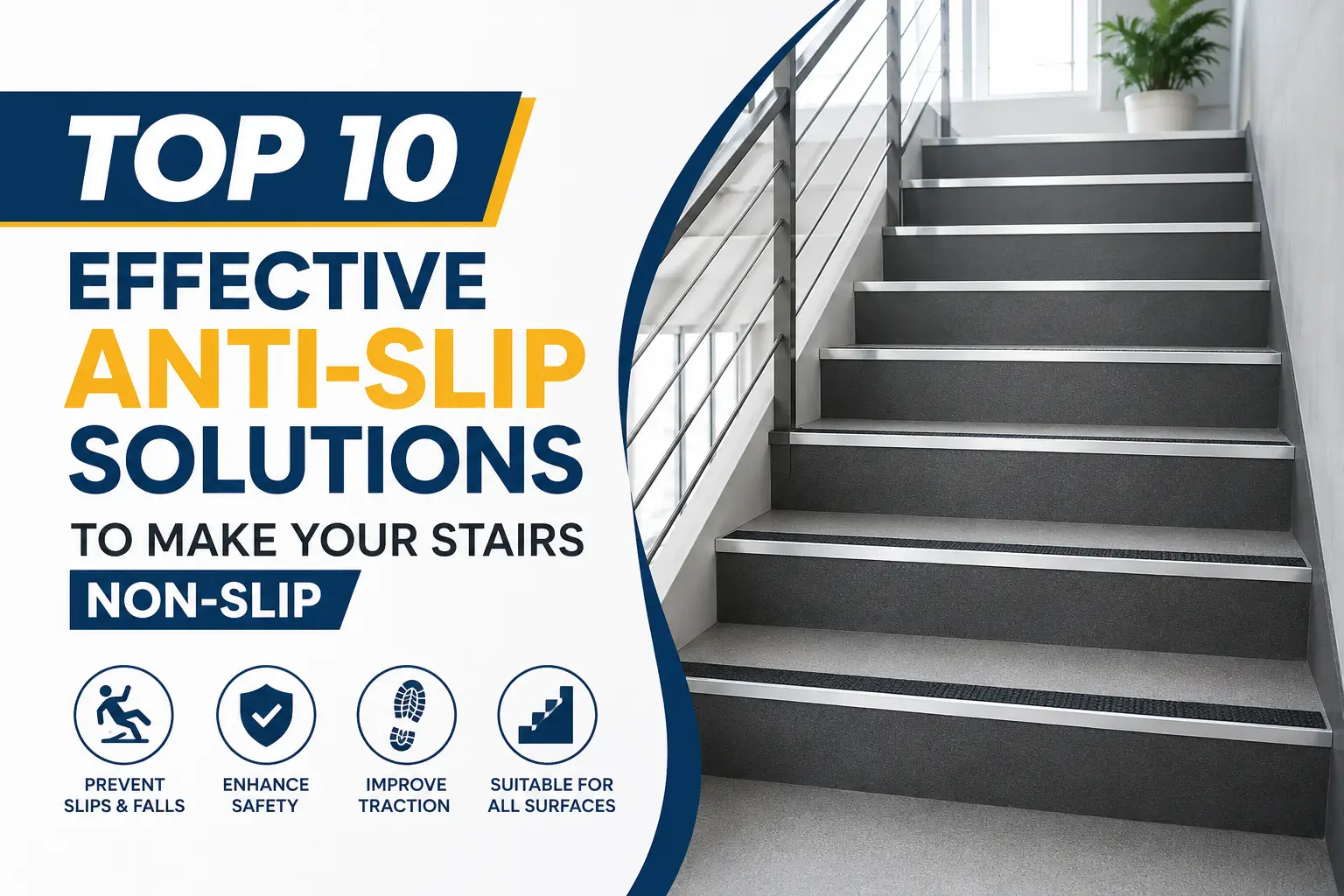
Without enough support, treads sag, bounce, and can eventually crack. Wide stairs with only two stringers feel springy in the middle.
How to avoid it
- Space stringers about 16 inches apart for typical 2× wood treads. A standard 36-inch-wide stair uses three stringers: one on each side and one in the middle. Wider stairs need four or more.
- Match spacing to the tread material. Thicker treads span farther: 2× lumber (1½") spans more than 5/4 decking (about 1"), and composite treads often require stringers 12 inches or less apart.
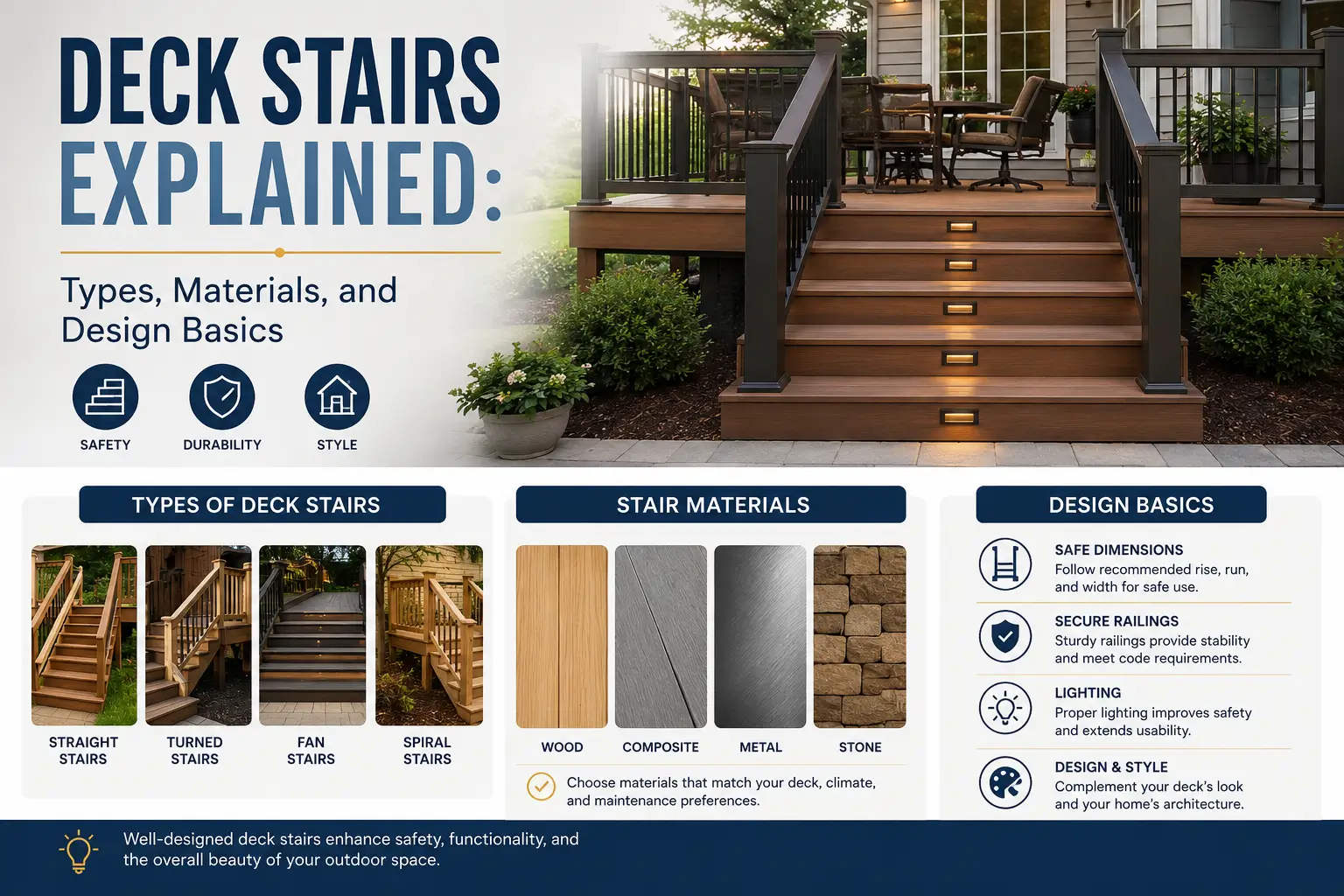
Mistake 7: Not checking local building codes
This is the mistake that can undo all your hard work. A beautiful stair that doesn’t meet code may fail inspection and have to be rebuilt. Codes cover the maximum rise, minimum run, headroom, width, landings, handrails, and guards.
How to avoid it
- Contact your local building department before buying materials, and get the stair requirements for your city or county. Codes vary, so don’t rely on generic information alone.
- Plan for inspection. Learn when inspections are required and build to pass the first time.
Frequently asked questions
What is the biggest mistake when building stairs?
Getting the total rise wrong. Every other calculation depends on it, so an error there makes the entire staircase uneven or unsafe.
Why is my first step taller than the rest?
The stringer wasn’t dropped. When you forget to cut the thickness of one tread off the bottom of the stringer, the first step ends up taller than the others once the treads are installed.
How do I fix a stair calculation error after the stringers are cut?
Small errors can sometimes be corrected by shimming at the top or bottom. For anything significant, the safest fix is to recut new stringers rather than compromise the structure.
Is it better to have more steps or taller steps?
More, shorter steps are almost always better. Taller risers save floor space but make stairs steeper and harder to use, and residential codes cap risers at 7¾ inches.
Does a stair calculator prevent all mistakes?
A calculator removes math errors and shows the layout, but it can’t fix a bad measurement. Its results are only as good as the total rise you enter, so measure carefully.
Build with confidence
On stairs, “measure twice, cut once” matters more than anywhere else. Avoid these seven mistakes, take your time with the planning, and check your math with the stair calculator. You will end up with stairs that are safe, comfortable, compliant, and something to be proud of.